Case Study
Tri-language Digital Newspaper with AI Translation
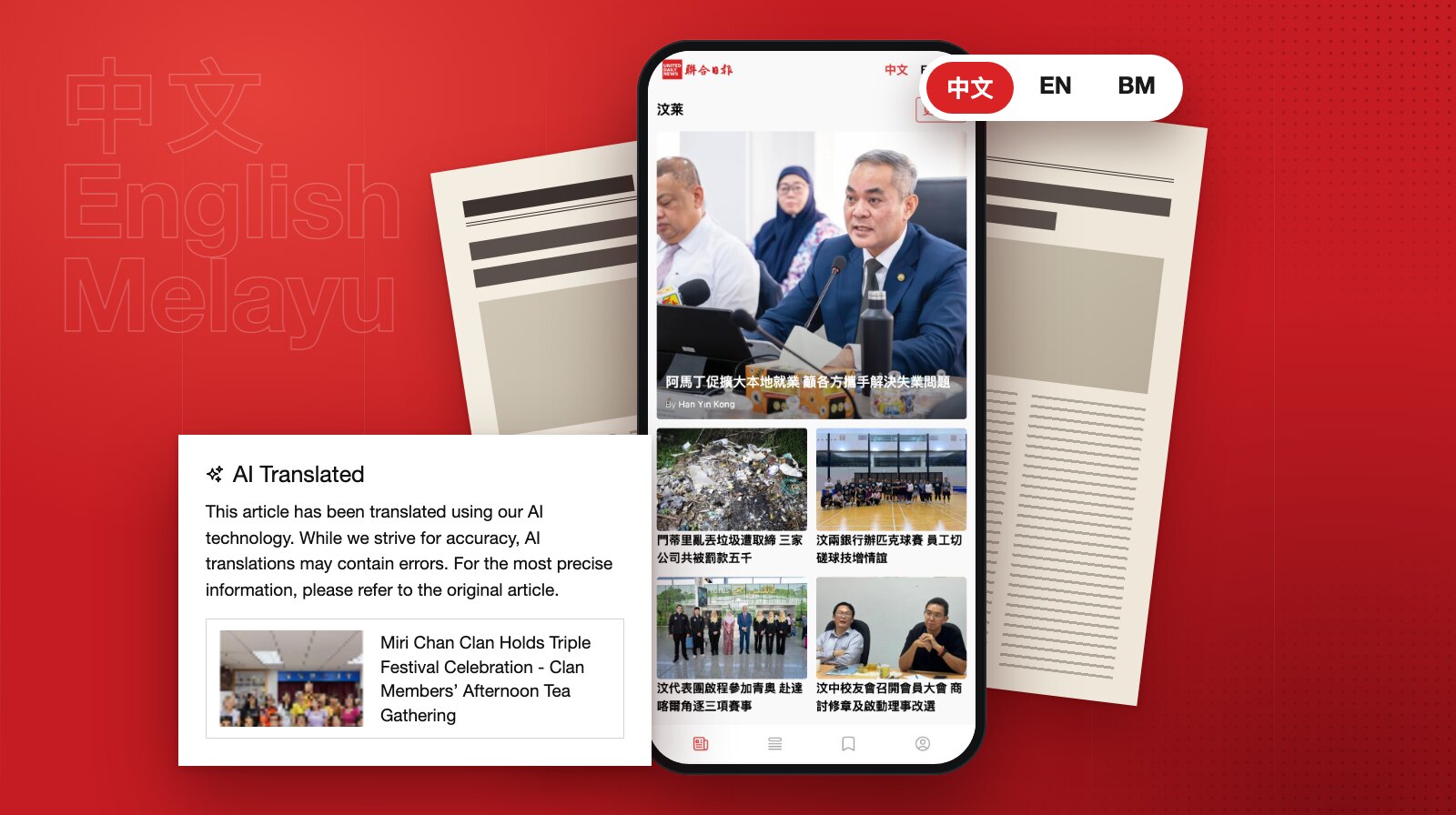
A mobile-first news site for United Daily News (联合日报), a licensed Sarawak daily with roots in 1945. Every story can be published in Chinese, English and Malay through AI translation that editors review before saving, and each translated page links back to the original. Subscriptions and ad slots are part of the platform.

Project Details
#AI Translation
#Web Development
United Daily News (联合日报) is a Chinese-language daily based in Miri, Sarawak, with a desk covering neighbouring Brunei. It was formed by merging two older papers, 美里日报 and 中华日报, first published in 1957 and 1945. Print is losing its readers in Malaysia: the share of people who use it as a news source fell from 45% in 2017 to 18% in 2025. United Daily's readers increasingly reach it on a phone, and its WordPress news portal could not handle high traffic and was often slow. The paper needed a site that stays quick under load and earns from digital readers through subscriptions and advertising, without giving up the accuracy a licensed newspaper answers for.
Speed decides how much gets read. In a Financial Times test, adding one second to page loads cut the number of articles subscribers read by 4.9% over a week, and a three-second delay cut it by 7.9% over four weeks. We replaced the portal with a custom Laravel application. Pages are rendered on the server and served through Cloudflare, and the home page HTML is about 14 KB compressed. The WordPress archive was imported in batches with each story's original ID kept, so old links redirect to the new pages, and the article tables are indexed by section and publish date so listings stay quick as the archive grows.
The reading design keeps the habits of a printed paper. The home screen is a front page: one desk after another (Sarawak, Brunei, National, International, Southeast Asia and more), each with a lead story under a full-width photo and smaller stories in a grid beneath it. The Feed works like turning pages. Each story fills the screen, and a swipe snaps to the next one, so a reader moves through the paper a page at a time. Readers can save stories for later, and a desktop layout serves the same paper on larger screens.
The centre of the project is publishing in three languages. A story is written once, in the language it was reported in. From the editor, one click asks a language model to translate it into either of the other two languages. Every translation is made from the original text, so a mistake in the English version cannot carry into the Malay one. The prompt keeps the article's HTML intact and leaves file names and links untranslated, so photos, embeds and formatting come through unchanged. The draft opens in the editor, where an editor reads and corrects it before saving, and each language version is recorded as either original or AI-translated. The model is a newsroom setting, so it can be changed without a code release.
Readers can always see which version they are reading. A translated article carries an “AI Translated” label. Tapping it explains that AI translations may contain errors and links to the original article, which remains the source of truth. The original reporting stays the record the paper stands behind, while the translations open it to readers of the other two languages.
Readers accept AI in this role far more readily than as a writer. Across six countries surveyed by the Reuters Institute in 2025, 53% of people were comfortable with AI translating news into other languages, while 12% were comfortable with news made entirely by AI. A US experiment found that readers trusted news less when it was labelled as AI-generated, even when they judged it no less accurate, and that the drop was largely offset when the article disclosed the sources it was built from. Linking every translation to its original applies the same idea to translated news. Language is also a measurable barrier to reach: when eBay introduced a new machine translation system, exports on the platform rose 10.9%.
Revenue is built into the platform. Subscriptions use a metered paywall: a reader gets a set number of free articles each month, a limit the newsroom sets, and a subscription opens everything after that. The newsroom can turn the paywall off, and subscriptions default to a year and are managed from the back office. Advertising has fixed places in the layout: a full-screen ad page after every third story in the Feed, a slot after the first paragraph of each article, and page-level tags. The newsroom fills each slot from the back office by pasting the ad code, and the live site runs Google AdSense and Google Ad Manager through them. Every article view and daily unique visit is logged and compiled overnight into reports, so editors can see what is being read.
United Daily News is live at uniteddaily.my.
Sources
- Zaharom Nain, Malaysia, Reuters Institute Digital News Report 2025, print as a news source in Malaysia, 2017 to 2025.
- Matt Chadburn and Gadi Lahav, A Faster FT.com (Financial Times, 2016), the page-delay experiment and its effect on articles read.
- Felix M. Simon, Rasmus Kleis Nielsen and Richard Fletcher, Generative AI and News Report 2025 (Reuters Institute), comfort with uses of AI in news in Argentina, Denmark, France, Japan, the UK and the US.
- Benjamin Toff and Felix M. Simon, “Or They Could Just Not Use It?” The Dilemma of AI Disclosure for Audience Trust in News (International Journal of Press/Politics), AI labels, trust and source disclosure.
- Erik Brynjolfsson, Xiang Hui and Meng Liu, Does Machine Translation Affect International Trade? Evidence from a Large Digital Platform (Management Science, 2019), machine translation and exports on eBay.