Case Study
AI Workforce for Businesses
A multi-tenant AI agent platform where small businesses across Southeast Asia put AI workers on their customer conversations, with every agent action staged, audited, and sealed inside its own tenant. We built the early platform; the StaffOS team scales it.

Project Details
#AI Agents
#AI Orchestration
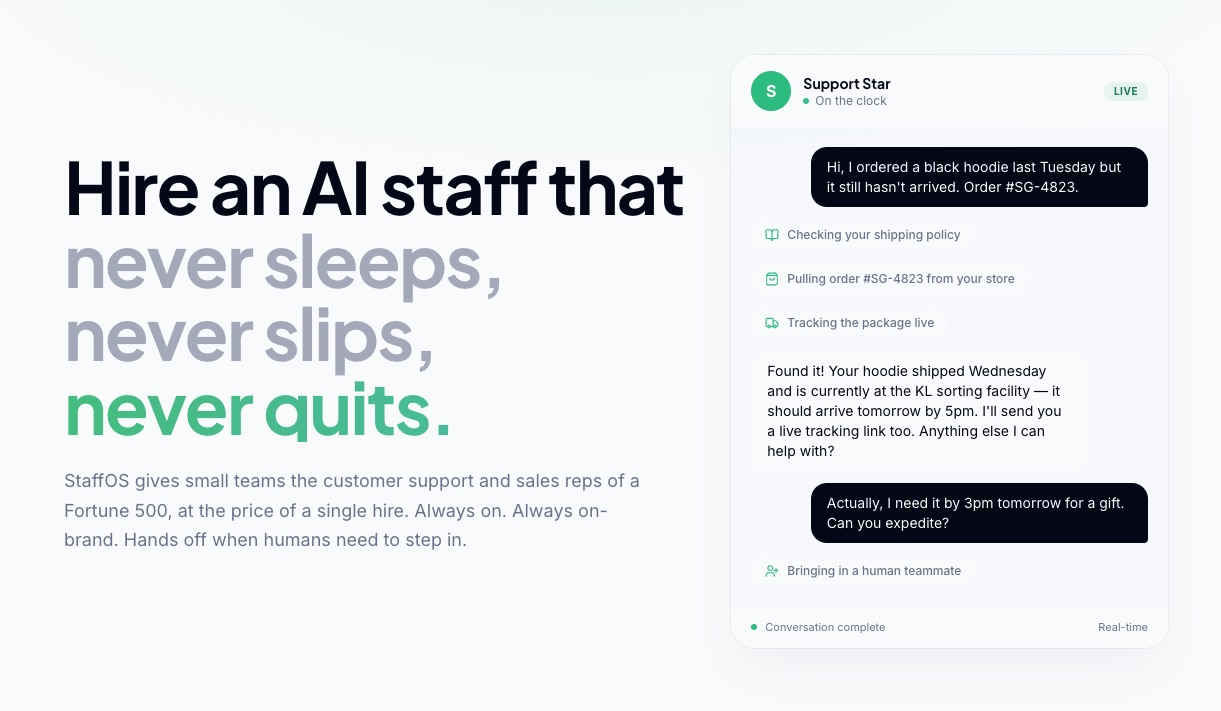
StaffOS is a multi-tenant AI agent platform for small businesses across Southeast Asia. A business stands up its own AI workers and points them at real customer conversations: an agent answers routine questions, qualifies and follows up on new enquiries, and hands a person the conversation the moment it needs one. Support and lead qualification are the first jobs tenants run on it, but the platform is the agents and the control plane around them, not any single use case. Astralab worked with the StaffOS team to bootstrap the product and build its early phase, the engineering foundation and the AI orchestration the agents run on. The StaffOS team has taken it from there to scale.
The hard requirement was governance, not chat. A business has to trust an agent that speaks to its customers, so every change an agent makes to a tenant's settings is staged, reviewed, and applied with a full audit trail, and each agent runs inside its own tenant boundary. We built that control plane early, together with the agent loop, the tool layer that lets a tenant connect its own systems for order lookups, shipping status, and a knowledge base, and the multi-tenant isolation underneath.
The review step is also where the agent gets better. Rather than fire a reply blind, the agent suggests one, and a person accepts, edits, or rejects it. Those decisions are kept and fed back, so the agent picks up a business's tone, its policies, and the right answer to a recurring question from real use. The same human review that governance demands doubles as a curriculum: the more the agent is corrected early, the less it needs correcting later. That suggested-then-reviewed loop is what makes it a self-learning agent rather than one frozen at the version it launched with.
An agent on WhatsApp meets real customers, including angry ones. A safety pass screens every inbound message before the agent engages, and when a conversation crosses a line, abuse, risk, or a direct request for a person, the agent silences itself and raises a ticket for a human to pick up. It also knows when to do nothing. Outside a real signal from the person on the other end, it stays quiet rather than filling a queue with follow-ups nobody asked for. Building that restraint was harder than building the replies: an agent that answers everything is trivial, while one that knows when silence is the right move takes a deliberate decision channel and a default of doing nothing until a real signal says otherwise.
The agents work in the messaging apps customers already use, such as WhatsApp, and speak to people in their own language across the region.
This case study is co-published with StaffOS, and the credit for where the product is today belongs with their team. Building it also shaped how we think about production agents, which we wrote up in An AI agent is not a prompt: the safety pass, the staged human-in-the-loop writes, and the choice to let an agent do nothing all came out of work like this.
The hard requirement was governance, not chat. A business has to trust an agent that speaks to its customers, so every change an agent makes to a tenant's settings is staged, reviewed, and applied with a full audit trail, and each agent runs inside its own tenant boundary. We built that control plane early, together with the agent loop, the tool layer that lets a tenant connect its own systems for order lookups, shipping status, and a knowledge base, and the multi-tenant isolation underneath.
The review step is also where the agent gets better. Rather than fire a reply blind, the agent suggests one, and a person accepts, edits, or rejects it. Those decisions are kept and fed back, so the agent picks up a business's tone, its policies, and the right answer to a recurring question from real use. The same human review that governance demands doubles as a curriculum: the more the agent is corrected early, the less it needs correcting later. That suggested-then-reviewed loop is what makes it a self-learning agent rather than one frozen at the version it launched with.
An agent on WhatsApp meets real customers, including angry ones. A safety pass screens every inbound message before the agent engages, and when a conversation crosses a line, abuse, risk, or a direct request for a person, the agent silences itself and raises a ticket for a human to pick up. It also knows when to do nothing. Outside a real signal from the person on the other end, it stays quiet rather than filling a queue with follow-ups nobody asked for. Building that restraint was harder than building the replies: an agent that answers everything is trivial, while one that knows when silence is the right move takes a deliberate decision channel and a default of doing nothing until a real signal says otherwise.
The agents work in the messaging apps customers already use, such as WhatsApp, and speak to people in their own language across the region.
This case study is co-published with StaffOS, and the credit for where the product is today belongs with their team. Building it also shaped how we think about production agents, which we wrote up in An AI agent is not a prompt: the safety pass, the staged human-in-the-loop writes, and the choice to let an agent do nothing all came out of work like this.