Case Study
AI-written Rednote (小红书) Posts from Real Customers
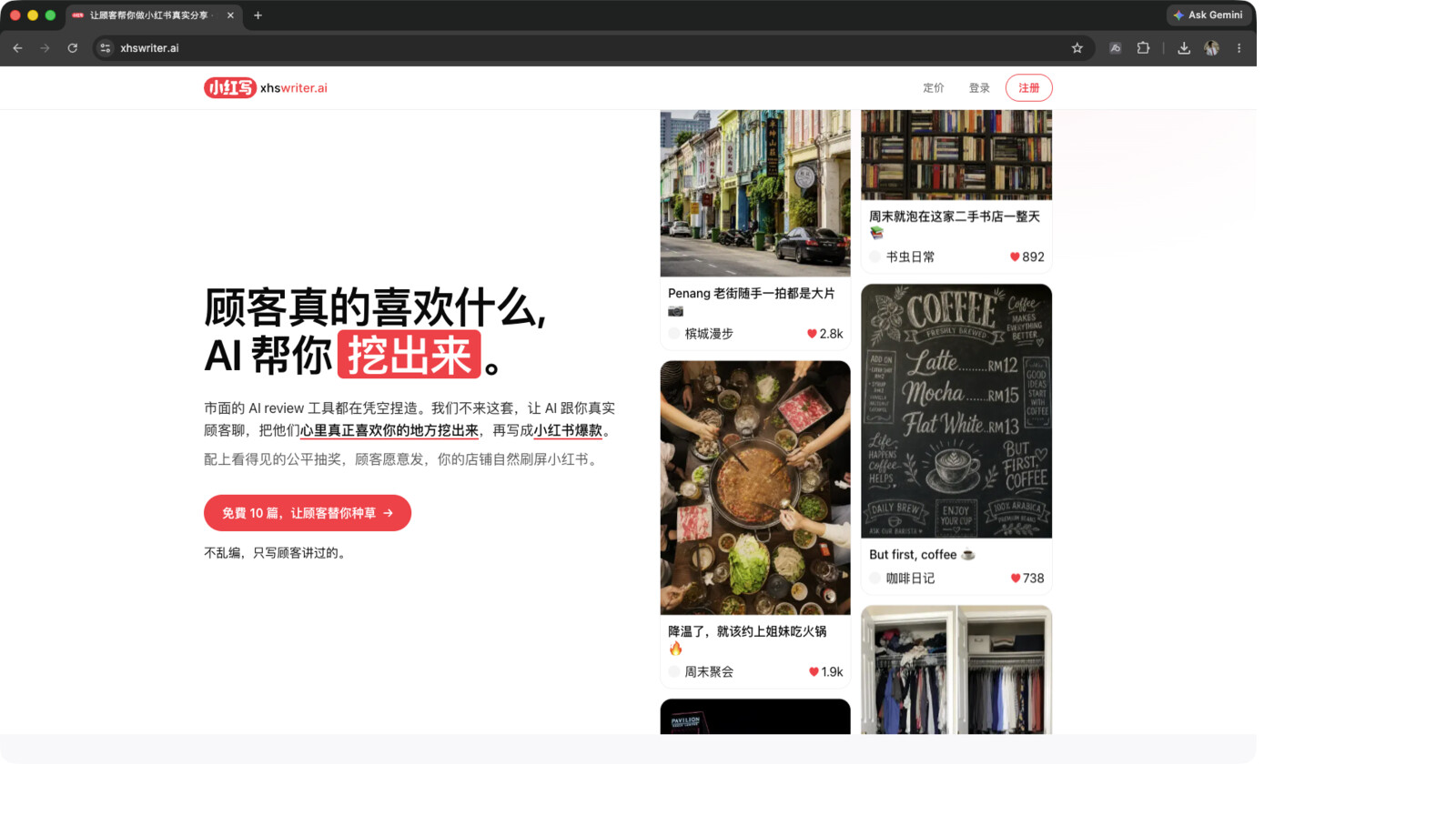
A self-serve platform that turns a merchant's customers into authentic 小红书 (rednote) content. A customer scans a QR, an AI interviews them about what they genuinely liked, then writes a publish-ready post, title, body, hashtags, and a composed cover, grounded only in what the customer said. Built for Malaysian small businesses running giveaway campaigns.

Project Details
#AI Agents
#AI Orchestration
小红写 XHSWriter helps small businesses earn real word of mouth on 小红书 (Rednote), where discovery in Chinese-speaking markets now happens. It is built around an uncomfortable truth: fabricated, AI-written reviews get detected and shadowbanned, so they do not work. But if it's genuine content from real customers, it becomes powerful. A merchant fills in a structured brand profile and prints a QR code for the counter. A customer scans it, and the platform takes over.
What looks like one 'generate' button is a chain of specialised AI steps. First the platform interviews the customer: a short conversational agent asks a few follow-up questions to draw out what they actually liked, the concrete detail a star rating never captures. Then it writes a publish-ready post from that material, a title, the body, hashtags, and a composed cover image, ready to publish to Xiaohongshu in a tap.
The engineering is in making that output trustworthy and consistent across thousands of posts. Generation is material-first: the system pulls concrete facts out of the customer's answers before any writing begins, and holds itself to using all of them, so a post never invents a dish nobody mentioned or quietly drops what the customer said. Titles are not free-written either; they are filled from a library of proven formulas, which keeps the voice and length right every time. A fast model does the quick triage while a stronger one does the actual writing, so quality lands where it counts without paying for it everywhere.
The cover image is its own small pipeline: vision reads the customer's photo for structure and colour, then a deterministic design engine, not a model improvising each run, composes a clean, on-brand cover that comes out the same every time. Running through all of it is a compliance layer that screens against Xiaohongshu's rules and advertising law, so the platform steers clear of the phrasing that gets a post silently buried. The output reads like a real person wrote it, because a real person's experience is exactly what it is built from.
XHS Writer is live at xhswriter.ai. The discipline behind it, the staged pipeline, the model split, and the refusal to let the model write anything the customer did not give it, is the same engineering we set out in An AI agent is not a prompt.
What looks like one 'generate' button is a chain of specialised AI steps. First the platform interviews the customer: a short conversational agent asks a few follow-up questions to draw out what they actually liked, the concrete detail a star rating never captures. Then it writes a publish-ready post from that material, a title, the body, hashtags, and a composed cover image, ready to publish to Xiaohongshu in a tap.
The engineering is in making that output trustworthy and consistent across thousands of posts. Generation is material-first: the system pulls concrete facts out of the customer's answers before any writing begins, and holds itself to using all of them, so a post never invents a dish nobody mentioned or quietly drops what the customer said. Titles are not free-written either; they are filled from a library of proven formulas, which keeps the voice and length right every time. A fast model does the quick triage while a stronger one does the actual writing, so quality lands where it counts without paying for it everywhere.
The cover image is its own small pipeline: vision reads the customer's photo for structure and colour, then a deterministic design engine, not a model improvising each run, composes a clean, on-brand cover that comes out the same every time. Running through all of it is a compliance layer that screens against Xiaohongshu's rules and advertising law, so the platform steers clear of the phrasing that gets a post silently buried. The output reads like a real person wrote it, because a real person's experience is exactly what it is built from.
XHS Writer is live at xhswriter.ai. The discipline behind it, the staged pipeline, the model split, and the refusal to let the model write anything the customer did not give it, is the same engineering we set out in An AI agent is not a prompt.